
As part of its continued focus on tax compliance and digitalisation, the UAE Ministry of Finance (“MoF”) has introduced Electronic Invoicing (“e-invoicing”) through Ministerial Decisions No. 243 and 244 of 2025 (the “Regulations”).
E-invoicing standardises tax invoices, requiring structured, data-driven electronic formats for issuance and reporting. The Regulations govern how business-to-business (“B2B”) and business-to-government (“B2G”) transactions are processed, recorded and reported electronically, with a phased rollout and plans to extend the framework to business-to-customer (“B2C”) transactions in the future.
Businesses within scope must engage an Accredited Service Provider (“ASP”) to integrate with the system and ensure compliance.
What is E-Invoicing?
E-invoicing is the electronic issuance, exchange, and storage of invoices in a structured, machine-readable format that enables automated processing between systems.
Unlike PDFs or paper invoices, e-invoices are generated in a prescribed digital format and exchanged through approved platforms or service providers. This enhances accuracy, transparency, and efficiency, while reducing manual errors and compliance risks.
Scope of E-Invoicing:
- All businesses operating in the UAE are required to comply with e-invoicing, unless explicitly excluded under the Regulations.
- Current exclusions are as follows:
- Sovereign activities of government entities that do not compete with the private sector.
- Certain international passenger and goods transportation services provided by airlines are exempt for a limited period.
- Financial services that are VAT-exempt or are eligible for zero-rating.
- An investment holding entity earning exclusively passive income, without undertaking any active commercial activities.
- Import of goods or services subject to reverse charge mechanism.
- B2C transactions are currently outside the scope of e-invoicing until further guidance is issued by the MoF.
E-Invoicing process – How it works for businesses:
- The seller prepares the invoice and submits the invoice details to its ASP.
- The seller’s ASP validates the information and converts it into the UAE-approved standard electronic invoice format, i.e., XML.
- The seller’s ASP securely transmits the e-invoice to the buyer’s ASP, which delivers it to the buyer.
- Simultaneously, the seller’s ASP transmits the relevant tax data to the government’s centralised e-invoicing platform.
- The government platform confirms receipt with an automated notification, completing the process.
|
|
How business can get ready for E-Invoicing?
- Assess impact: Check if your business is in scope and identify your implementation phase. Determine what systems and processes need updating.
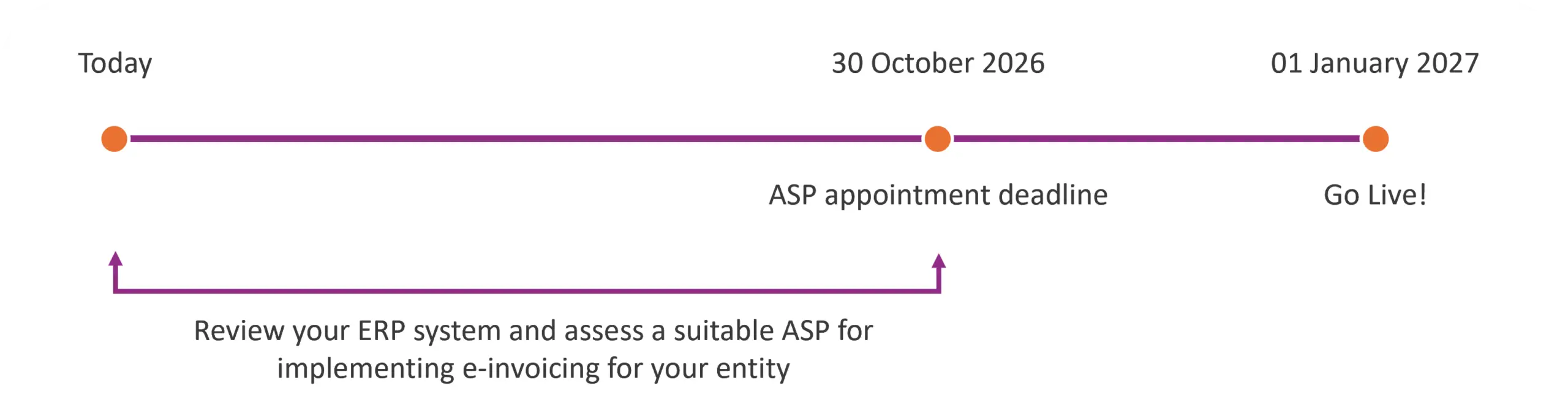
- Appoint ASP: From the published list of ASPs by MOF, evaluate ASPs, select the right solution, and plan onboarding in alignment with project timelines. The selection of an ASP should be based on a company’s accounting system compatibility, current and projected transaction volumes, and overall cost efficiency.
- Redesign processes: Update workflows, data flows, and systems, and test thoroughly before go-live.
- Review ERP and invoicing platforms: Assess if current systems can generate and transmit structured e-invoices and credit notes. Develop a project plan to address any gaps.
- Strengthen compliance controls: Establish internal policies for reporting, record retention, system downtime, and audit readiness to ensure ongoing compliance.
E-invoicing is reshaping VAT compliance in the UAE. Businesses that prepare early, update systems, and align processes can ensure a smooth rollout, stay compliant, and boost efficiency and transparency.
How can we help
Re/think provides tax, optimization, registration, implementation, compliance, and training services in UAE.
We designed our Corporate Taxation services to suit high-growth firms and their specific business needs at each stage of advisory, implementation, subsequent tax compliance, and management.
With our team of tax, finance experts, and tax accountants, we can provide you with a bundle of services, ensuring the implementation is cost-effective.